
Effective October 1, 2026
Reduced from 343 ft to 200 ft
Tennessee 811 Notification Buffer Reduction
Tennessee 811 is reducing the standard Notification Buffer applied to locate requests from approximately 343 feet to 200 feet. Here is what members need to know.
What is the Notification Buffer?
When an excavator calls in a locate request or submits a ticket online, the proposed excavation area is mapped with a point, line, or polygon based on the site description and marking instructions. This mapped area serves as the basis for which utilities are notified about the excavation.
Tennessee 811 then automatically applies a Notification Buffer that expands beyond that mapped excavation area. The buffer is an added precaution applied to all tickets to help account for possible mapping discrepancies or measurement errors.
The current 343-foot Notification Buffer may result in notifications to utilities whose mapped service areas intersect the larger buffer, even when their underground facilities are not close enough to the actual proposed excavation area to be in conflict.
The Notification Buffer is not the same as the Tolerance Zone, which is a 24-inch zone on either side of a marked underground facility where excavators are required to use reasonable care during excavation to avoid damage.
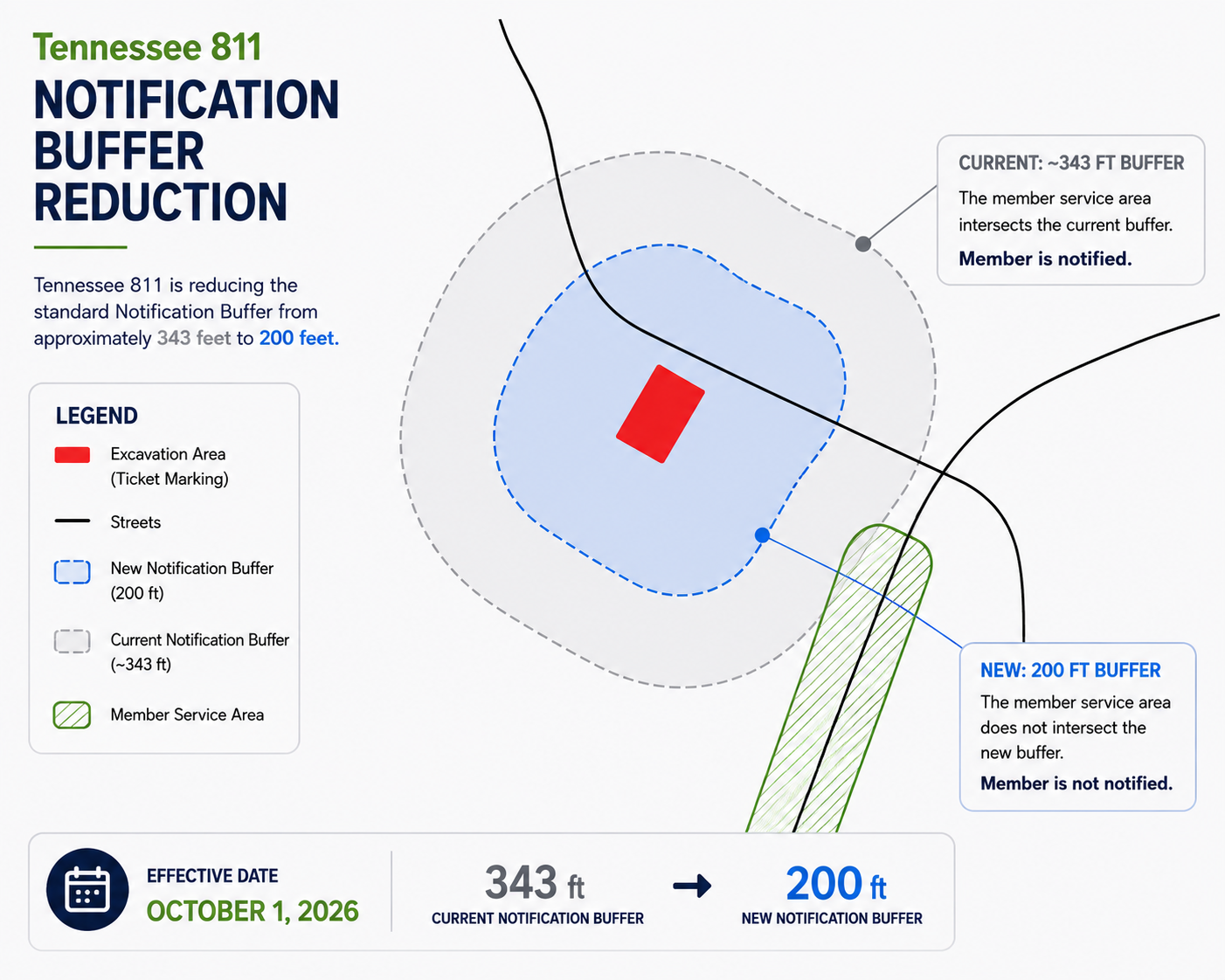
What is changing?
Current Ticket Notification Buffer: Approximately 343 feet
New Ticket Notification Buffer: 200 feet
Effective Date: October 1, 2026
Why is Tennessee 811 reducing the buffer?
The reduction is intended to help decrease over-notification of members.
A smaller Notification Buffer allows ticket notifications to be more closely focused on members whose mapped service areas are nearer to the proposed excavation.
How does the change benefit members?
- Lower operational costs- Members are less likely to receive notifications for excavation activity farther from their mapped service areas, reducing unnecessary ticket review and “Clear - No Conflict” or “No Marking Needed” responses. A reduction in unnecessary notifications that require a locator response may result in cost savings for a member utility.
- Better resource allocation and response- Reducing unnecessary ticket notifications may help members respond more efficiently to locate requests within their service area and focus on tickets that have a greater likelihood of affecting member underground facilities.
How does the change benefit excavators?
If fewer utilities, on average, are notified on a locate request, an excavator has fewer utility responses to account for. Efficient utility responses to underground locate requests improve safety, may reduce project delays, and make the overall 811 process more reliable.
The Notification Buffer is not the same as a member’s Service Area
A reduction in the Tennessee 811 Notification Buffer does not reduce or change a member’s existing service area in Tennessee 811’s database.
These are separate geographic areas:
- Notification Buffer: Automatically applied by Tennessee 811’s system around a mapped excavation area on a ticket
- Member Service Area: The geographic area established for the member, by the member, and used to determine when that member is notified on a locate request.
A member concerned that the reduced Notification Buffer could negatively affect its ticket notifications should review its existing service area with Tennessee 811 and explore whether that area should be adjusted or expanded.
Concerned about your current service area?
Members who want to review their current service area can begin by visiting the Service Area Editor (SAE) page: https://www.tenn811.com/sae
Members with an existing account can access the SAE platform there. Members without an account can request one through the same page.
Tennessee 811’s GIS team can also assist members with evaluating their current mapped service area.