

Excavation Safety Guide
Damage to underground utility lines can cause far-reaching consequences, from serious injury and environmental damage to the loss of vital services we depend on every day.
Preventing damage to these facilities is a responsibility shared by all stakeholders, accomplished through various damage prevention measures.
This page provides basic information on safe excavation practices in Tennessee.
It is intended as an educational resource only, so please be advised of the following:
- This is not a legal reference. You should consult your attorney, if necessary, for advice on interpreting the law.
- It does not contain the complete text of TCA 65 31 101-120. You can find the full text version of the law here.
- The information in this booklet is subject to change without notice.
- We do not have a copyright on the material in this manual and you are encouraged to copy all or part of it as needed. If you would like additional copies, we will be more than happy to provide them to you.
About Tennessee 811
Established in 1983, Tennessee 811 serves as the statewide official one-call center. Tennessee 811 does not mark lines but functions as a communications link between our member utilities and anyone excavating.
Tennessee’s Underground Utility Damage Prevention Act (TCA 65-31-101) requires everyone who digs to contact Tennessee 811 at least three (3) working days’ notice before starting a project. Tennessee 811 processes the notification of proposed excavation and notifies our member utilities, or their contract locators, to mark their underground facilities prior to the excavation.
This free service helps prevent damage incidents which can result in millions of dollars in property damage, the interruption of utility service, personal injuries, and even loss of life.
Tennessee 811 is a non-profit governed by a Board of Directors.
Uniform Color Code
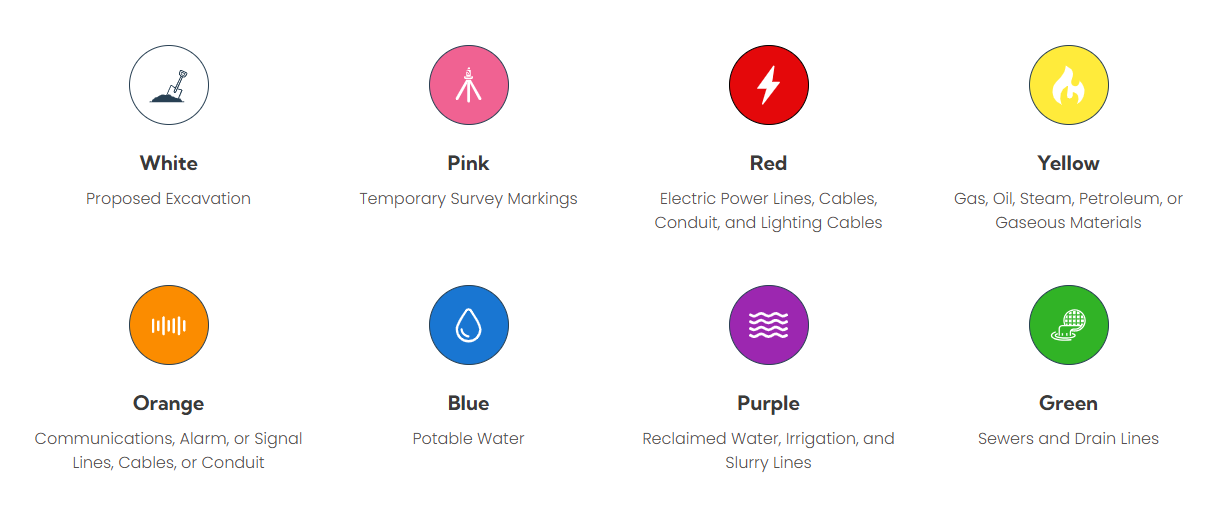
The uniform color code is used for marking excavation sites and underground facilities in conflict with an excavation.
Underground facilities may be marked on the ground in either paint, stakes, or flags.
Before You Contact 811
Safe digging is everyone’s responsibility, but excavators have more responsibilities under the law and higher risk if the proper processes aren’t followed. Submitting a ticket is the first step but it’s not the only step, and sometimes it takes more than just the one call.
View the Steps to Safe Digging here.
Damages
Precautions to avoid damage
TCA 65-31-110
Always contact Tennessee 811 for locates before digging.
Hand dig, pothole or use vacuum excavation if working within the safety or tolerance zone to expose existing utilities.
Stay at least two (2’) feet away from locate marks.
Never assume the depth of any underground facility.
Always pre-survey the work area, looking for signs of underground or buried facilities: pedestals, pole drops, warning signs, evidence of new or fresh trench-line, manhole lids, etc.
A word about Warning Markers:
Some utilities use warning signs to warn of the proximity of their underground facilities.
The warning sign is not normally placed directly on top of the facility.
The facility may be anywhere in the area of the sign.
The absence of a warning marker doesn’t mean the absence of underground facilities – Always contact Tennessee 811 for utility locates before you begin your work.
Protect and preserve the color code markings.
Protect and support exposed facilities during excavation.
Don’t assume that a pipeline or cable runs straight between markers.
Don’t work off of someone else’s ticket.
What to do if damage occurs
TCA 65-31-111
If during the course of excavation an underground facility has been damaged, state law requires you to notify the utility operator immediately of the location and nature of the damage.
You must give the operator reasonable time to accomplish necessary repairs before continuing work in the immediate
area of the facility.
Do not try to repair the facility yourself or to cover up the damages.
If damage permits the escape of any flammable, toxic or corrosive gas or liquid, you are to notify the operator, police and fire departments immediately and take other action that may be necessary to protect persons and property and to minimize the hazards until arrival of the operator’s personnel or police and fire department.
Operators Must Report Damages
65-31-111 (d)
Each operator whose utility facilities have been damaged must report the incident using the Damage Information Reporting Tool (DIRT) utilized by the Common Ground Alliance.
Operators may contact Tennessee 811 for information on this requirement.
Design Locate
TCA 65-31-118 – Design Locate Request
Any person may submit a design request to Tennessee 811 within fifteen (15) working days.
The facility owner or operator must respond by 1 of 3 methods:
- Locate all utility facilities and sewer laterals in the proposed area.
- Provide to the person submitting design locate request the best available description of facilities in the area, which might include drawings of existing facilities and sewer laterals in the area.
- Allow person submitting design locate request to inspect a copy of the drawings or records of existing utilities and sewer laterals in the area.
Educational Opportunities
Tennessee 811 offers in person and online education on a variety of topics related to The Underground Damage Prevention Act.
Tennessee 811 Damage Prevention Liaisons travel all over the state to give presentations about the importance of notifying 811 before digging.
There is no charge for this and the presentations can be tailored to meet the needs of your company.
The Tennessee 811 website also has valuable information about safe digging practices.
You can view the Tennessee Damage Prevention Act in its entirety by visiting our website or mobile app.
Contact the center at (615) 367-1110 to learn more or to schedule a presentation.